Why a Mechanism is Needed
Chapter 2 described that waves modulate one another. This chapter describes how. If everything is wave, every event in the universe — every touch, every collision, every act of growth, every breakdown — is reducible to a single question: what happens when two wave systems meet?
The six principles below are not new physics. They are a re-reading of physics already in the textbooks, organised so that the same explanation covers a falling raindrop, a chemical bond, an evolving species, and a pain signal in your fingertip. Where the principles map onto well-established work, that work is cited. Where they extend beyond, the extension is flagged.
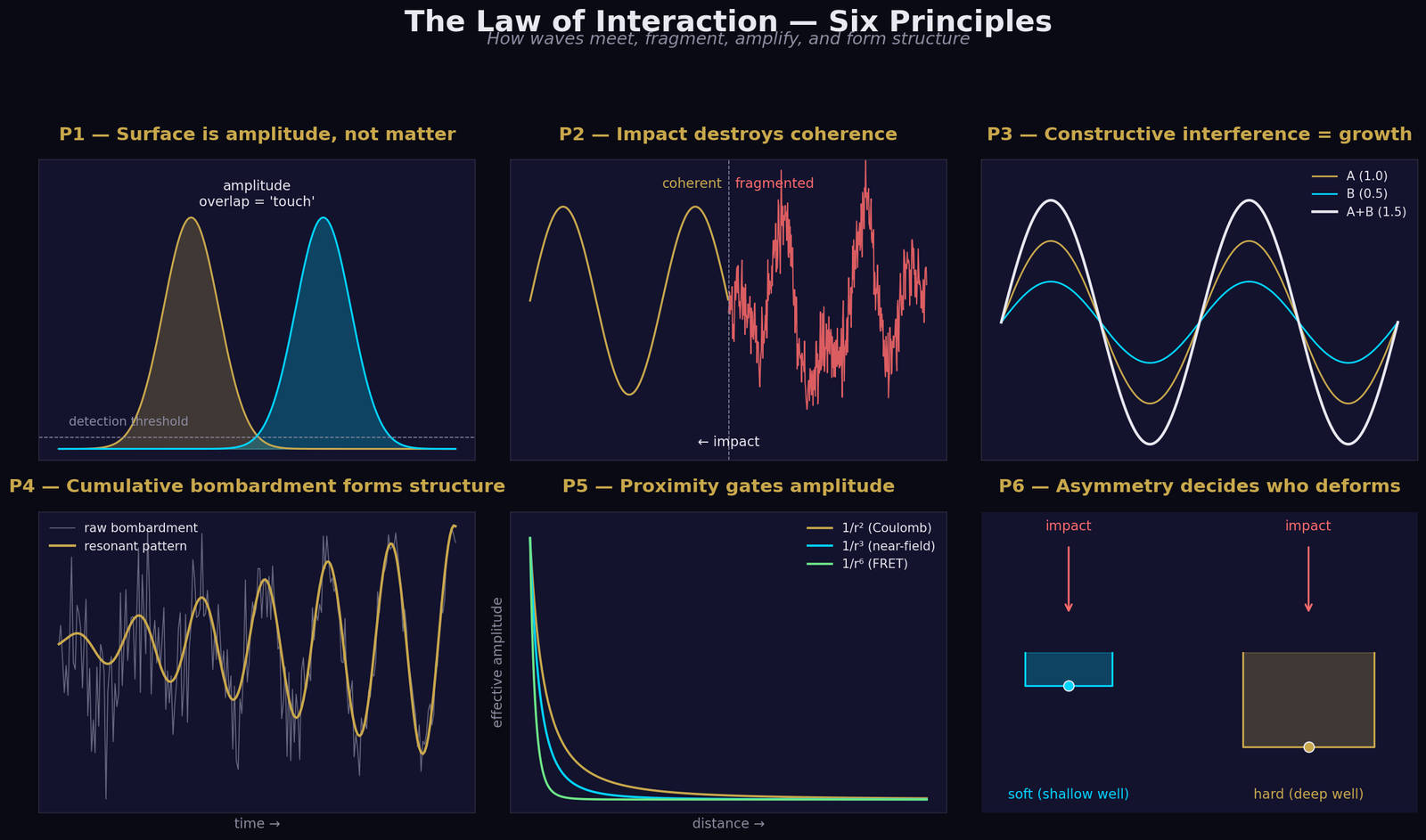
Principle 1 — The Surface is Amplitude, not Matter
What we call the "edge" of an object is not a hard line. It is the place where the combined wave amplitude of the object falls below the threshold the surrounding field can detect. Beyond that line, the amplitude tapers off into the vacuum.
Touching is never matter touching matter. Two atoms cannot physically meet because they are not balls — they are wavefunctions. What we feel as contact is the moment two amplitude peaks begin to overlap and interfere.
This is the stability of matter theorem. Lieb & Thirring proved rigorously in 1975 that bulk matter neither collapses nor explodes specifically because electrons obey the Pauli exclusion principle. The reason you do not fall through your chair is not that the atoms in the chair are "solid" — it is that no two electrons in your hand and the chair can occupy the same quantum state. Pauli repulsion is the force of contact.
Lieb–Thirring stability of matter, Phys. Rev. Lett. 35, 687 (1975):
Builds on Dyson & Lenard (1967–68), proves that the ground-state energy of N electrons and K nuclei is bounded below by a constant times (N + K). The fermion nature of electrons is essential — without Pauli exclusion, matter would collapse. This is the rigorous backbone of the wave-amplitude-boundary picture: the "edge" of objects is where electron density drops below detection, and contact forces are short-range Pauli repulsion.
A subtle implication: hardness and softness are not properties of matter, they are properties of the amplitude gradient at the boundary. A hard surface has a steep gradient — amplitude drops off fast. A soft surface has a shallow gradient — the wave can penetrate further before resistance builds. This is why soft tissue gives, and rock does not.
Principle 2 — Impact Destroys Coherence
When two waves of large amplitude difference are forced together, the result is not addition but fragmentation. The orderly oscillation breaks into a spectrum of incoherent small waves — what physicists call decoherence, what thermodynamics calls entropy increase, and what we ordinarily call damage.
A coherent wave. Press Impact to shatter its phase relationships — and notice you cannot Reset back to the same wave from the fragments alone.
Picture a car at 100 km/h hitting a concrete wall. On a molecular scale, the orderly standing-wave structure of the steel — its crystal lattice — is scattered into chaotic frequencies: heat, sound, deformation. The wall barely notices because its standing-wave structure is far more deeply locked. The car cannot be reconstructed from the wreckage because the phase information that defined its original arrangement has been dispersed.
This is the second law of thermodynamics seen through a wave lens. Entropy increase is the loss of phase coherence to an environment too large to track. You can identify the pieces of a broken vase; you cannot reassemble the structure.
Zurek's decoherence program, Rev. Mod. Phys. 75, 715 (2003):
Quantum decoherence — the loss of phase coherence to an environment — formalised the transition from quantum superpositions to classical-looking outcomes. Recent work (e.g. arXiv:2509.07077, 2025) extends this into a derivation of the second law from pure decoherence in open systems. A sober note: decoherence (loss of coherence to an environment) and thermodynamic irreversibility (genuine entropy export) are parallel mechanisms of information loss, not the same mechanism. The Spectrum framing unifies them at a higher level of description; the technical machinery still distinguishes them.
Principle 3 — Constructive Interference is Growth
When two waves meet in phase, their amplitudes add. A wave of amplitude 1 plus a wave of amplitude 0.5 in phase produces a wave of amplitude 1.5. Out of phase, they partially cancel. Anything in between produces a more complex resultant wave.
Growth, in every domain, is this same arithmetic. A crystal grows by selectively capturing only those atoms whose oscillation matches its lattice. Out-of-phase arrivals are repelled; in-phase arrivals lock in. This is why crystals can be grown so pure — they are selective resonance amplifiers.
Move the phase to π for destructive cancellation. Reduce proximity to see amplitude attenuate.
Try the lab above: matched amplitudes in phase produce a louder wave. Antiphase with matched amplitude cancels to silence. Drop the proximity slider to see the interaction fade out as distance grows. These four sliders are, between them, four of the six principles in this chapter.
Neural learning has cleaner support than the deeper "DNA replication as wave matching" claim. Hebbian plasticity has been formalised as oscillator phase coupling: synaptic weights strengthen when pre- and post-synaptic activity is phase-aligned (Nicola & Clopath, 2021). Skill acquisition, memory consolidation, the feeling of "clicking" with another person — these are real instances of in-phase wave reinforcement.
Hebbian plasticity as oscillator coupling — Nicola & Clopath, Biol. Cybernetics 115:43 (2021):
Demonstrates that classical Hebbian learning rules give stronger synaptic weights for neurons whose activity is at simple integer phase ratios. This is exactly what "in-phase amplification = growth" predicts. Together with synthetic Turing-pattern work (CIMA reaction since Castets et al. 1990, with renewed materials studies in Frontiers in Physics 2024), this makes Principle 3 the strongest of the six in mainstream support.
Principle 4 — Cumulative Bombardment Forms Structure
Imagine a wave field bombarded for years, centuries, millions of years by waves from its surroundings. Some arrive in phase and amplify the existing pattern. Some arrive out of phase and erase it. What remains is whatever could stay resonant under that specific environmental spectrum.
This is selection by resonance, and it explains durable structure on every timescale — from picoseconds (chemical bond formation) to billions of years (stellar nucleosynthesis).
The mathematical engine is stochastic resonance: noise plus a weak periodic signal plus a nonlinear system produces enhanced signal output. The noise itself becomes an amplifier of resonant patterns. Counter-intuitive, but ubiquitous in physics, biology, and engineering.
The deeper engine is Prigogine's dissipative structures: open systems far from equilibrium spontaneously form ordered patterns by selecting the modes that survive. Hurricanes, convection cells, living organisms — these are not exceptions to entropy. They are entropy's most efficient export mechanisms, and they form exactly where cumulative wave selection finds a stable mode.
Stochastic resonance — Gammaitoni, Hänggi, Jung, Marchesoni, Rev. Mod. Phys. 70:223 (1998); updated Nat. Rev. Phys. 4:551 (2022):
The mathematical framework for "noise plus nonlinearity plus weak signal = amplification." For Spectrum's framework, this is the cleanest existing physics for "cumulative bombardment forms structure." Combined with Prigogine's dissipative structures and the Hoyle 12C resonance — the literal reason carbon atoms exist in the universe — Principle 4 survives scientific scrutiny strongly.
Stellar nucleosynthesis offers the cleanest single example: the carbon-12 nucleus exists in our universe at all because Hoyle predicted, and Cook–Fowler–Lauritsen experimentally confirmed in 1957, a precise resonance state that allowed three alpha particles to fuse into carbon during stellar collapse. Without that resonance, no carbon. Without carbon, no chemistry of life.
Evolution can be read as a special case: an organism that resonates with its environment's frequency spectrum (food sources, climate, predators, partners) survives. What is out of phase is broken down. "Survival of the fittest" becomes "survival of the most resonant" — a productive metaphor that recent oscillator-selection models begin to formalise.
Principle 5 — Proximity Gates Effective Amplitude
Waves attenuate with distance. Sound thins, light dilutes, magnetic fields weaken. Interaction is only effective within a radius where amplitude remains high enough to induce resonance. Past that radius, effective amplitude approaches zero.
Three concrete examples make the principle vivid:
- Fertiliser must reach root depth. Not because the roots "must see" the nutrients, but because the chemical concentration gradient — a kind of slow chemical wave — falls off rapidly with distance. Fertiliser ten metres away has effective amplitude zero at the root.
- Heat must contact the liquid to boil it. A flame under the pot delivers phonon-amplitude directly through conductive contact. The same flame thirty centimetres away from the pot dissipates into the air — same energy released, almost no transfer.
- Electrolysis requires current through water. The electric field must directly interfere with the O–H bond's binding wave to break it. A field at distance polarises water slightly but does not break the bond.
Distance-attenuation laws are not all 1/r²:
Coulomb and gravity fall as 1/r² (power conservation through expanding spheres). Near-field dipole fields fall as 1/r³. Förster resonance energy transfer (FRET) between fluorophores falls as 1/r⁶ — a doubling of distance reduces efficiency 64-fold (Stryer & Haugland, 1967, "spectroscopic ruler"). Casimir–Polder forces fall as 1/r⁷ at retarded distances. The exponent depends on the interaction. What is universal is that interaction is amplitude-gated by distance.
This is also why digital communication cannot fully replace physical presence. A video call transmits the visual and auditory wave components but not the electromagnetic, thermal, or chemical (pheromone) components, which only transfer at human-scale proximity. The interaction is partial.
Principle 6 — Amplitude Asymmetry Decides Who Deforms
When two wave systems collide, the one with higher coherence — deeper standing-wave locking — preserves its form. The other deforms. This is why a 100 km/h car is destroyed against a concrete wall and not the other way around. The wall's lattice has higher cumulative amplitude-coherence than the car's kinetic wave.
Hardness is the depth of the potential well that holds atoms in their lattice positions. Harder material = deeper well = more energy required to displace an atom from its standing-wave node.
Mainstream materials science already supports this picture qualitatively. Bloch waves describe electrons in crystals as standing waves whose nodes coincide with atomic positions. Hardness theory derives microhardness from bond density and energy gap (Gao et al., Phys. Rev. Lett. 91:015502, 2003).
Two Sharper Tests
Racemic mixtures as destructive interference
A clean test of the framework is already in the medicine cabinet. A racemic mixture contains equal amounts of a molecule and its mirror image — the L-form and the D-form. Such mixtures are optically inactive: they rotate polarised light not at all, because the two rotations cancel. This is destructive interference of chirality.
Pharmacologically, the picture is more nuanced. Thalidomide is the classical example: one enantiomer was therapeutic, the other teratogenic. But thalidomide also racemises in vivo (half-life ≈ 2.5 hours at physiological pH; Scientific Reports 8:17131, 2018), so the simple "good enantiomer / bad enantiomer" story is itself simplified. Ibuprofen is taken as a racemate, and the inactive R-form is enzymatically converted in vivo to the active S-form.
What survives this nuance is the optical claim: equal-and-opposite chirality cancels its detectable rotational signature. The wave-cancellation principle is real and visible in a polarimeter.
Light in antiphase: already demonstrated
A natural extension is whether two coherent waves of opposite phase can fully cancel. For sound, this is noise-cancelling headphones — established consumer technology. For light, it is destructive interference, also established: anti-reflective coatings on eyeglasses, the dark fringes of double-slit experiments, the dark output port of a balanced Michelson interferometer.
Total cancellation requires that every frequency component be matched in antiphase. Monochromatic light can be cancelled cleanly. Broadband white light is much harder, because the phase shift on reflection is itself frequency-dependent. This is why a perfect "anti-mirror" across the full visible spectrum does not exist as a single device — it would have to apply a precisely tuned π phase shift at every wavelength simultaneously.
Water and the Phases of Chirality
Water, alone among ordinary molecules, exists in all three phases (solid, liquid, gas) at habitable temperatures. This means it constantly cycles between three regimes of chiral ordering, and that cycling makes it uniquely suited as a wave-interface between living systems and their environment.
Transient chiral water domains — established 2012–2024:
Pérez et al. (2012) reported water-trimer chirality and tunneling between enantiomers in microwave spectroscopy. McDermott et al. (PNAS 114:9776, 2017) showed biomolecular chirality is imprinted on exactly one hydration layer. Sun et al. (Nature Communications 10:935, 2019) demonstrated chirality amplification in confined water cages. Bulk liquid water has no net chirality, but transient chiral H-bond domains on picosecond timescales are demonstrated. Ice has chiral polymorphs (notably ice XI). Plasma loses molecular chirality entirely.
What Survives This Audit
A short scorecard of the six principles, set against current evidence:
- P1 (surface as amplitude) — strongly supported (Pauli exclusion, Lieb-Thirring).
- P2 (impact = decoherence = irreversibility) — qualitatively right; conflates decoherence with coarse-graining.
- P3 (constructive interference = growth) — strongly supported for Hebbian and Turing; speculative for "DNA wave matching."
- P4 (cumulative resonance = structure) — strongly supported (stochastic resonance, dissipative structures, Hoyle resonance).
- P5 (proximity gates amplitude) — strongly supported qualitatively; the specific 1/r² law is one of several attenuation regimes.
- P6 (amplitude asymmetry) — qualitatively supported by hardness theory; the Mohs↔chiral-inversion-energy hypothesis is novel and untested.
The framework holds where it touches established physics. Where it extends beyond, it is offered as a research program, not a proof.
Three New Predictions
Prediction #42 — Hardness gates chiral inversion
The energy required to invert the chirality of a molecule embedded in a solid matrix should scale with the hardness of that matrix on the Mohs scale (or Vickers/Knoop). Testable with chiral guest molecules in mineral lattices of varying hardness, measuring inversion barriers via temperature-dependent NMR.
Prediction #43 — Forensic phase-information limit
Forensic reconstruction of impact-fragmented samples has a fundamental information-theoretic limit set by phase-information loss. Two impacts that produce visually similar wreckage from chemically identical starting materials should be distinguishable by fragment-orientation entropy only above a threshold collision energy. Below that threshold, classification is not theoretically possible.
Prediction #44 — Time-cumulative cymatic structure
Sustained low-frequency mechanical bombardment (cymatics-time experiments) of an initially uniform colloidal suspension should produce stable banded structures whose mode frequencies match integer multiples of the driving frequency, in proportion to exposure duration. Faraday-wave research already supports this for short timescales — Kharbedia et al. (Nature Communications 2021, doi 10.1038/s41467-021-21403-0) showed that soluble (bio)surfactants can freeze Faraday-wave patterns into stable 2D-hydrodynamic crystals via surface-rigidity coupling. The novel claim here is the time-cumulative dependence extending into bulk colloidal suspensions.
Why This Chapter Matters
Until now, the manuscript has described what waves are (Chapter 1) and that they modulate (Chapter 2). This chapter has described how the modulation produces structure, growth, decay, and damage. Without it, the rest of the book is a list of analogies. With it, the analogies become consequences of one consistent mechanism.
The Law of Interaction is the clutch between Coherence theory and the rest of the universe. Without it, the gears spin freely. With it, motion transfers.
Last updated: